
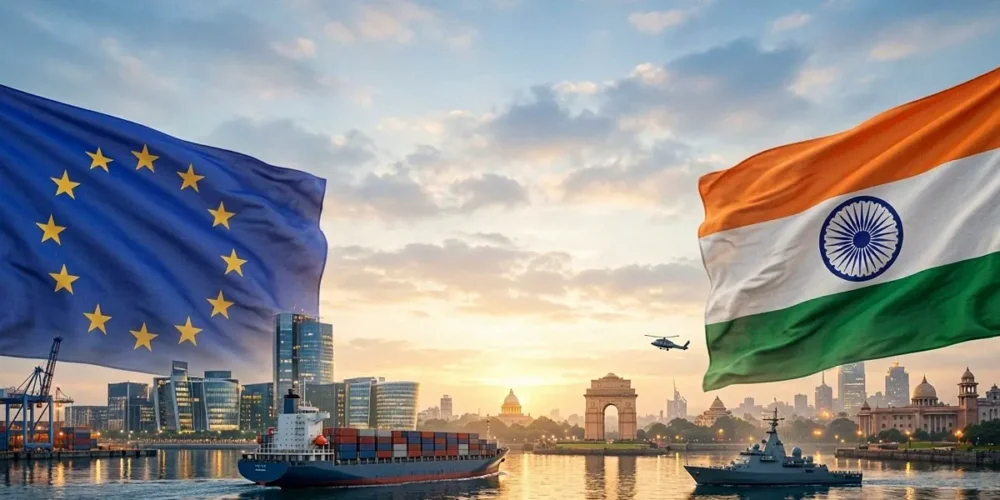
EU–India Relations: Trade and Security
It is one of the strangest paradoxes in global diplomacy. The European Union and India have called each other “strategic partners” since 2004, yet nearly two decades of on-and-off negotiations have still not produced a free trade agreement. Both sides talk about shared values, the rules-based order and the Indo-Pacific. Both sides publish glossy roadmaps. And yet, when we look at the actual deliverables — tariff schedules, data rules, defence contracts — the gap between rhetoric and reality remains wide. That is starting to change, and the reasons are geopolitical as much as economic.
Why EU–India Relations Matter More Than Ever

The strategic environment has shifted dramatically since the mid-2000s. China’s rise, Russia’s full-scale invasion of Ukraine in 2022, and intensifying US–China rivalry have pushed Brussels and Delhi into each other’s orbit in ways neither fully anticipated. For the EU, India is now the indispensable partner in the Indo-Pacific — too large to ignore, too non-aligned to control, and too important to the future of the multilateral trading system to leave on the shelf.
Two institutional moments crystallised this shift. The EU–India Trade and Technology Council launched in 2022, creating a structured forum for cooperation on semiconductors, AI, clean tech and digital standards. A year later, India’s G20 presidency in 2023 gave Delhi a global platform to shape narratives on debt restructuring, climate finance and food security — and Brussels paid close attention.
From Strategic Partnership to Strategic Necessity
We would argue the language has quietly changed. “Strategic partnership” implied a choice; “strategic necessity” implies there is no alternative. With supply chains being re-engineered, critical minerals contested, and semiconductor capacity concentrated in East Asia, the EU needs diversified partners. India, with its 1.4 billion consumers, growing manufacturing base and democratic institutions, fits the brief better than almost anyone.
The Shadow of China and Russia
India’s refusal to condemn Russia’s war in Ukraine frustrated Brussels, and Delhi’s continued purchases of discounted Russian crude remain a sore point. At the same time, India’s border clashes with China and its wariness of Belt and Road dependency have made it a more receptive partner for EU infrastructure and connectivity offers. The result is a relationship built on overlapping interests rather than shared positions.
The Long Road to an EU–India Trade Deal
FTA talks were launched in 2007, suspended in 2013 after 16 rounds failed to bridge differences, and relaunched in June 2022. Since then, negotiators have met regularly, but the substance remains hard. As of our most recent reading, the chapters on goods, services, investment, competition and intellectual property are still under negotiation.
What Brussels Wants from Delhi
The EU’s priority list is familiar from other Asian FTAs:
- Steep cuts to Indian tariffs on cars, wines and spirits — currently among the highest in the G20
- Predictable, transparent rules for European investors in India
- Access to India’s public procurement market
- Stronger protection for geographical indications such as Champagne and Parma ham
- Alignment on sustainability chapters, including the EU’s Carbon Border Adjustment Mechanism (CBAM)
What Delhi Wants from Brussels
India’s asks are equally concrete. Delhi wants the EU to recognise its data protection regime as “adequate” under GDPR, which would unlock services trade and ease the compliance burden on Indian IT firms. It wants mobility provisions for professionals, faster visas for skilled workers, and a carve-out from CBAM, which Indian steel and aluminium exporters view as protectionism in green clothing. India also wants tariff concessions on textiles, leather and generic pharmaceuticals.
Can the FTA Be Finished by 2025?
Both sides have signalled ambition to conclude by 2025, but we are sceptical of hard deadlines. Agriculture was excluded from the mandate, which removes one historic obstacle, yet cars, data and carbon remain unresolved. A more realistic outcome may be a phased agreement — an early harvest on some chapters, with the hardest files pushed to a later stage.
Security and Defence: From Dialogue to Deployments
Trade gets the headlines, but security cooperation is moving faster. The EU and India hold regular security and defence consultations, and Indian naval vessels have participated in EU-led escort operations in the Gulf of Aden, protecting shipping from Houthi attacks and piracy. Joint exercises, port calls and intelligence exchanges have become routine.
Maritime Security and the Indo-Pacific
India’s Indo-Pacific vision and the EU’s own Indo-Pacific strategy overlap on freedom of navigation, anti-piracy and humanitarian response. The Gulf of Aden is the clearest operational test case — a shared chokepoint where both Brussels and Delhi have direct economic interests.
Defence Industrial Cooperation
France is India’s key European defence partner, with the Rafale fighter jet and Scorpene submarine deals anchoring the relationship. Other member states, including Germany and Spain, are now courting Delhi on submarines and naval platforms. The EU’s defence industrial strategy opens the door to joint research and co-production, but India’s procurement rules and offset requirements remain friction points.
Counterterrorism and Cyber
Counterterrorism dialogue and cyber consultations have produced modest but real outcomes: information-sharing on extremist networks, capacity-building for Indian agencies, and joint positions in UN forums. Cyber is where we see the greatest untapped potential — both sides face state-linked threats and both are building sovereign digital infrastructure.
Strategic Autonomy: What It Means for EU–India Ties
Strategic autonomy is the phrase that ties the whole relationship together. Brussels wants the capacity to act independently of Washington and Beijing; Delhi has practised a form of autonomy for decades. The overlap is real, but so is the friction.
Brussels’ Vision of Autonomy
For the EU, strategic autonomy means de-risking supply chains, building European defence capacity, and projecting infrastructure influence through the Global Gateway plan — Brussels’ answer to China’s Belt and Road Initiative. Global Gateway has earmarked billions for connectivity projects in Africa, Asia and Latin America, and India is a natural co-investor.
India’s Multi-Alignment Strategy
India does not want to be anyone’s junior partner. It buys Russian oil, participates in the Quad with the US, Japan and Australia, and deepens ties with the EU — all simultaneously. Multi-alignment is not indecision; it is a deliberate strategy to maximise leverage.
Convergence and Friction
Where the two converge: connectivity, clean energy, critical minerals, digital standards, WTO reform. Where they diverge: Russia, sanctions enforcement, and the pace of decarbonisation commitments. Managing that mix, rather than pretending it does not exist, is the real work of EU–India diplomacy.
What This Means for the UK
Post-Brexit Britain is watching all of this closely — and for good reason. The UK–India free trade agreement negotiations, launched in 2022, are still ongoing, with chapters on services, investment and intellectual property among the sticking points. Meanwhile, the UK’s CPTPP accession was confirmed in 2023, giving London a Pacific-facing trade identity for the first time.
The UK–India FTA Track
The UK has an advantage the EU lacks: no common external tariff to negotiate across 27 member states, and a services-heavy economy that matches India’s growing demand. But it also has less leverage — no single market access to offer, and a smaller trade basket than the EU’s.
Complement or Competitor?
We see both. On defence, the UK competes with France for Indian contracts. On services and fintech, it complements EU firms. On trade rules, London and Brussels are effectively bidding for Delhi’s attention — and Delhi is happy to play them off each other.
Lessons for British Trade Policy
The EU–India experience offers three lessons for UK negotiators:
- Deadlines slip; institutional resilience matters more than political theatre.
- Data adequacy and mobility are as important as tariffs.
- Security cooperation and trade deals now move together — you cannot separate them.
EU–India relations are finally moving from communiqués to concrete deliverables: naval coordination, a functioning Trade and Technology Council, and a trade negotiation that, while unfinished, is at least alive. The UK cannot simply ride on Brussels’ coat-tails. It needs its own India strategy — one that plays to British strengths in services, defence and fintech, while accepting that Delhi will always keep its options open.
FAQ
When did EU–India free trade talks begin?
Negotiations were launched in 2007, suspended in 2013 after 16 rounds, and formally relaunched in June 2022.
What is the EU–India Trade and Technology Council?
Launched in 2022, it is a structured forum for cooperation on semiconductors, AI, clean tech, digital standards and resilient supply chains.
Is India part of the EU’s Global Gateway plan?
India is a key partner for Global Gateway, the EU’s infrastructure and connectivity initiative positioned as an alternative to China’s Belt and Road.
How does the UK–India FTA differ from the EU’s talks?
The UK negotiates bilaterally and can move faster on services, but lacks the single market access and combined trade weight that Brussels brings to the table.
What is the biggest obstacle to an EU–India trade deal?
Tariffs on cars and wines, India’s demand for data adequacy under GDPR, and EU carbon border rules remain the hardest unresolved files.