
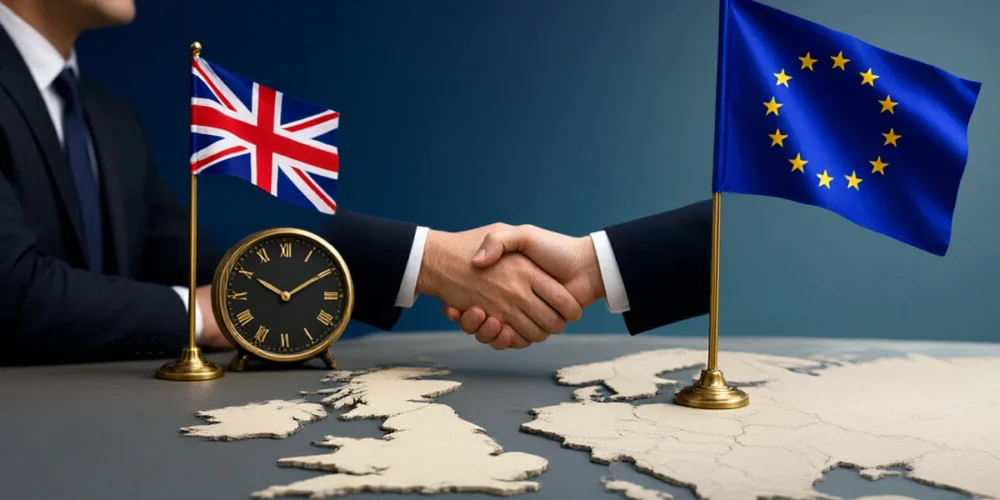
UK-EU Relations Heading into the New Year: Key Issues Explained
Since Brexit, the UK-EU relationship has moved through denial, disruption and, more recently, a cautious kind of pragmatism. What began as a divorce negotiation has slowly become something closer to a working arrangement between neighbours who cannot afford to ignore each other. As we head into the new year, that relationship feels like it is approaching a genuine crossroads. The easy arguments have been had, the hardest trade-offs are still unresolved, and both sides now face a calendar of decisions — from the Trade and Cooperation Agreement (TCA) review to EU enlargement — that will determine whether the reset everyone talks about actually materialises. We think this is the year to watch closely.
The State of Play: Where UK-EU Relations Stand Now

The baseline for UK-EU relations remains the TCA, supplemented by the Windsor Framework for Northern Ireland and a growing habit of leader-level engagement through forums like the European Political Community (EPC). The recent UK-EU summit in Brussels signalled that both sides want to move beyond post-Brexit rancour, even if the legal architecture has not yet caught up with the political mood.
The Trade and Cooperation Agreement: Still Fit for Purpose?
The TCA governs UK-EU trade and is due for review in 2026. It delivered tariff-free goods trade, but it did so with substantial new paperwork, border checks and regulatory divergence baked in. We see the review as the single most important scheduled moment in the relationship. Neither side wants a full renegotiation, but both have incentives to smooth the roughest edges — particularly around rules of origin, conformity assessment and mobility for business travellers.
The Windsor Framework and Northern Ireland’s Dual Access
The Windsor Framework addresses post-Brexit trade issues for Northern Ireland by creating green and red lanes for goods, protecting the EU single market while keeping Northern Ireland inside the UK customs territory. It has reduced political temperature in Belfast, but businesses still report complexity. The framework’s success matters not just for Northern Ireland but as a test case for how the UK and EU can manage divergence without confrontation.
Diplomatic Reset Under the New UK Government
Keir Starmer’s government has signalled a clear reset, prioritising a closer, more structured relationship with Brussels. Ursula von der Leyen and other EU leaders have responded positively, though with the familiar caveat that the single market’s integrity is non-negotiable. The tone has improved; the substance is still being negotiated.
Trade Barriers and the Cost of Friction
Trade friction is where the rhetoric meets the invoice. UK exporters continue to face customs declarations, VAT complications and rules-of-origin checks that many small firms simply cannot absorb. The Office for Budget Responsibility has repeatedly flagged that Brexit has weighed on UK trade intensity, and the anecdotal evidence from exporters backs that up.
Customs and Regulatory Burden on UK Exporters
Small and medium-sized exporters are hit hardest. Larger firms can afford dedicated compliance teams; smaller ones often give up on EU markets altogether. Sectors like fishing, agriculture and automotive have been particularly vocal about the costs. A UK-EU veterinary agreement and mutual recognition of professional qualifications are two of the most concrete asks from industry.
The Case for a Veterinary Agreement
A veterinary agreement would dramatically reduce checks on agri-food trade, which currently faces some of the heaviest border friction. The EU has signalled openness in principle, but only if the UK accepts dynamic alignment with EU rules in this area — a politically sensitive concession. We think the economic case is strong, particularly for Northern Ireland and for UK food producers who depend on just-in-time supply chains.
Services and Professional Mobility: The Unfinished Business
Services make up around 80% of the UK economy, yet the TCA covers them thinly. The City of London remains Europe’s largest financial centre and a key point of negotiation, with equivalence decisions still patchy. Professional mobility is another gap: architects, lawyers, engineers and doctors all face new barriers to working across the Channel. Expect these issues to feature prominently in any TCA review discussions.
European Security and Defence Cooperation
Russia’s war in Ukraine and instability in the Middle East have pushed security cooperation up the agenda. The UK and EU share threat assessments and, increasingly, operational interests. The question is how to institutionalise that cooperation without reopening the Brexit settlement.
Ukraine and the Logic of Joint Support
Joint support for Ukraine has been one of the most effective areas of UK-EU cooperation since 2022. Military assistance, sanctions coordination and reconstruction planning have all benefited from closer working. We expect this to deepen, particularly as US political attention shifts.
NATO, the EU, and the UK’s Role in European Defence
NATO remains the cornerstone of European defence, but the EU’s own defence initiatives — from the European Defence Fund to permanent structured cooperation (PESCO) — are increasingly relevant. The UK participates in some via third-country arrangements, but not all. The European Political Community (EPC) has emerged as a useful platform for UK-EU leaders to meet outside formal EU structures.
Intelligence Sharing and Hybrid Threat Response
Intelligence sharing and hybrid threat response are areas where the UK and EU have strong mutual interests. Coordinated responses to cyberattacks, disinformation and sabotage attempts are already happening informally. Formalising them would be a win for both sides.
EU Foreign Policy Shifts and the UK’s Global Role
The EU’s foreign policy is evolving, and the UK’s global posture is shifting too. Sometimes these movements align; sometimes they collide.
China Policy: De-risking vs. Engagement
The EU’s de-risking strategy on China emphasises reducing critical dependencies without full decoupling. The UK’s approach is broadly similar, but with a stronger Indo-Pacific tilt driven by AUKUS and CPTPP membership. Convergence is real but fragile, especially on technology and investment screening.
The Global South and Development Cooperation
Both the UK and EU are courting the Global South, particularly on critical minerals, energy and infrastructure. Competition here is real, and coordination is patchy. We think there is room for smarter joint approaches, particularly in Africa.
Climate Diplomacy and the Energy Transition
Climate diplomacy remains a shared priority, though the UK’s decision to weaken some net-zero commitments has raised eyebrows in Brussels. The energy transition — renewables, grid interconnection, hydrogen — offers genuine opportunities for cooperation, especially in the North Sea.
What to Watch in the New Year: Key Dates and Decisions
Several upcoming events will shape the relationship:
- The TCA review in 2026, which will set the tone for the next phase of trade relations.
- UK trade negotiations with the US and India, which will influence the UK’s leverage with the EU.
- EU enlargement discussions, particularly regarding Ukraine, Moldova and the Western Balkans.
- The aftermath of the European Parliament elections, which has shifted the political balance in Brussels.
The TCA Review and Potential Renegotiation
The TCA review is not a renegotiation by default, but it is an opportunity. We expect both sides to focus on targeted improvements rather than wholesale change.
UK Trade Deals with the US and India
Progress on US and India deals would strengthen the UK’s hand in Europe — or expose how much the UK still depends on its nearest market. Either way, it matters.
EU Enlargement and Its Impact on the UK
EU enlargement will reshape the bloc’s internal dynamics, its budget and its external borders. For the UK, a larger EU means a different negotiating partner — one that may be harder to align with on trade and security.
Our Take: Why This Year Matters for UK-EU Relations
Our view is that this year is genuinely pivotal. The political window for a pragmatic reset is open, but it will not stay open indefinitely. The biggest opportunities lie in trade facilitation — a veterinary agreement, mutual recognition of qualifications and smarter customs processes — and in security cooperation, where interests are closely aligned. The biggest risks are complacency and domestic politics on both sides. High-stakes sectors include the City of London, which needs equivalence and market access clarity; the NHS, which depends on EU-trained staff and medical supply chains; and UK universities, which rely on EU research funding and student exchanges that Brexit has made harder. Getting these right would deliver tangible gains.
FAQ
What is the Trade and Cooperation Agreement (TCA)?
The TCA is the treaty that governs UK-EU trade and cooperation post-Brexit. It is due for review in 2026.
What is the Windsor Framework?
The Windsor Framework addresses post-Brexit trade issues for Northern Ireland, creating green and red lanes for goods moving between Great Britain, Northern Ireland and the EU.
What is the European Political Community (EPC)?
The EPC is a forum that provides a platform for UK-EU leaders and other European leaders to meet and discuss shared challenges, including security and energy.
How does Brexit affect UK universities?
UK universities rely on EU research funding and student exchanges, both of which have been affected by Brexit. Rebuilding those links is a priority for the sector.
Why does the City of London matter in UK-EU negotiations?
The City of London remains Europe’s largest financial centre and a key point of negotiation, particularly around equivalence and market access for financial services.
While the UK-EU relationship remains complex and occasionally fraught, the coming year offers a genuine chance for a pragmatic reset that serves both sides’ interests. We will be watching closely — and reporting on what actually changes, not just what is announced.