

Europe and East Asian Economic Integration: Shaping EU Trade Policy
The European Union trades more with East Asia than with any other region outside its own single market. Japanese cars, South Korean batteries, Taiwanese semiconductors and Chinese consumer goods flow into European ports in staggering volumes, while European luxury brands, machinery and pharmaceuticals flow the other way. Yet for all this commercial depth, the EU still struggles to speak with one voice on strategic autonomy. Member states disagree on how tough to be with Beijing, how much to spend on domestic chip production, and whether trade policy should serve security goals at all. That tension — between deep economic integration with Asia and the political ambition to act autonomously — is the thread running through this analysis.
The Architecture of EU–Asia Trade: Agreements, Dialogues and Dependencies
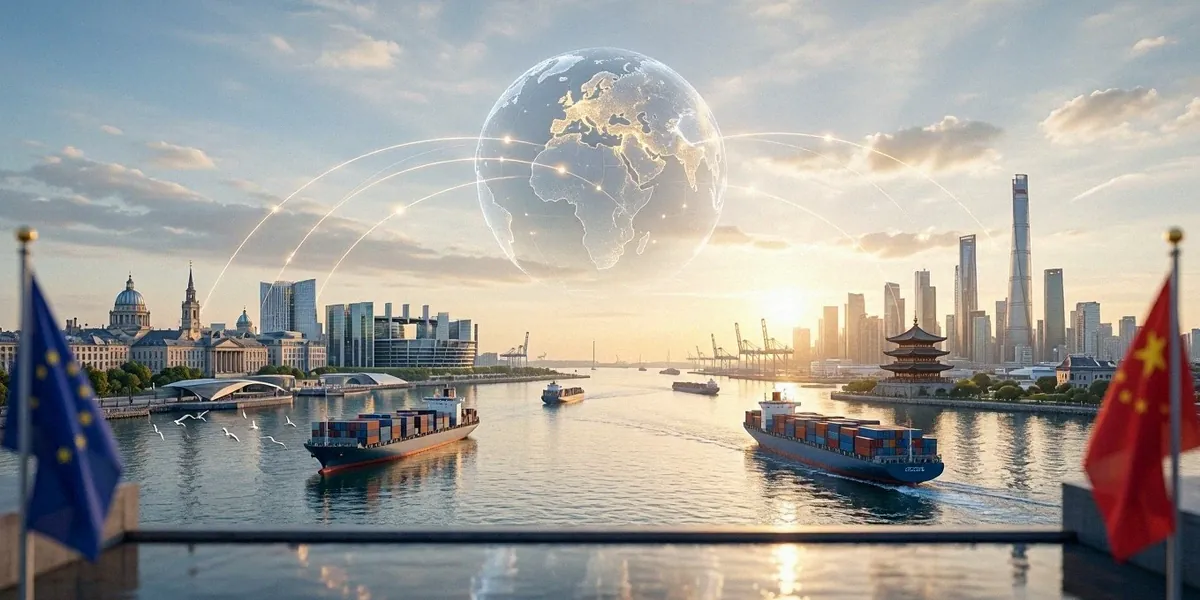
We map the EU’s trade architecture with East Asia as a patchwork rather than a single design. Brussels has concluded some of its most ambitious bilateral deals in the region, yet its relationship with the two largest economies — China and Taiwan — rests on no comprehensive trade agreement at all. That asymmetry shapes everything from tariff schedules to investment screening.
Key bilateral trade agreements in force
The EU–Japan Economic Partnership Agreement, in force since 2019, covers nearly 600 million people and a third of global GDP, making it one of the largest trade deals ever signed. The EU–South Korea free trade agreement, operational since 2011, was the first of the EU’s “new generation” deals with a major Asian economy and remains a template for provisions on labour, environment and competition. Talks with Indonesia and Thailand have advanced unevenly, with palm oil, fisheries and automotive tariffs among the sticking points. Vietnam’s EVFTA, in force since 2020, gave European exporters a foothold in one of Asia’s fastest-growing markets.
Sectoral dialogues and regulatory cooperation
Beyond tariffs, the EU operates a dense network of sectoral dialogues with Asian partners. These cover digital trade, green technology standards, competition policy and sanitary rules for food. Regulatory cooperation matters more than headline tariff cuts in sectors like automobiles, where Japanese and Korean manufacturers must navigate EU emissions rules, and in pharmaceuticals, where mutual recognition of inspections saves both sides time and money. We see these dialogues as the unglamorous plumbing of EU–Asia trade — rarely newsworthy, but essential to keeping goods moving.
The China challenge: de-risking without decoupling
China remains the EU’s largest source of imports and its second-largest export market. Brussels has adopted the language of “de-risking” rather than “decoupling,” a distinction that matters enormously in practice. De-risking means reducing dependence in critical sectors — semiconductors, rare earths, pharmaceuticals — while maintaining broad commercial ties. The EU’s anti-subsidy investigation into Chinese electric vehicles, launched in 2023, tested that balance. Beijing retaliated with probes into European brandy and pork, reminding Brussels that asymmetric dependence cuts both ways.
Strategic Autonomy Meets Asian Supply Chains: Rhetoric and Reality
Strategic autonomy has become the organising concept of EU foreign and trade policy. In practice, it collides with hard economic realities: Europe depends heavily on Asian suppliers for the technologies and materials underpinning its green and digital transitions.
Critical dependencies: chips, minerals and green tech
The European Chips Act aims to double the EU’s share of global semiconductor production to 20% by 2030, up from roughly 10%. Whether that target is achievable is another question — advanced fabrication depends on equipment, talent and capital concentrated in Taiwan, South Korea and the United States. The Critical Raw Materials Act sets benchmarks for domestic extraction, processing and recycling of minerals like lithium, cobalt and rare earth elements, most of which are currently refined in China. European battery gigafactories in Germany, Poland and Hungary reduce dependence on Asian cells, but they still rely on Asian cathode materials and machinery.
The EU’s de-risking toolkit: anti-coercion instrument and FDI screening
Brussels has assembled a set of defensive instruments:
- The Anti-Coercion Instrument, agreed in 2023, allows the EU to impose trade restrictions when a third country uses economic pressure to change EU policy.
- The Foreign Direct Investment Screening Regulation coordinates national reviews of inward investment on security grounds.
- The International Procurement Instrument limits access for foreign firms from countries that exclude EU bidders from public contracts.
- Export controls on dual-use technologies, tightened since 2022, target advanced chips and quantum equipment.
Each tool raises the same question: does Europe have the political cohesion to use it? Hungary and Greece have repeatedly signalled reluctance to confront Beijing, while France and the Netherlands push for a harder line.
How Asian capitals read European autonomy
Tokyo and Seoul largely welcome European engagement as a counterweight to Chinese dominance, and both have deepened security and technology ties with Brussels. Beijing reads strategic autonomy as code for protectionism and alignment with Washington. ASEAN capitals see opportunity — they want European investment as firms diversify away from China — but worry about being caught between great powers. We think the EU’s credibility in Asia depends less on rhetoric than on whether it can deliver ratified agreements and predictable regulation.
The UK Factor: Brexit, the CPTPP and Britain’s Asian Pivot
Brexit removed the UK from EU trade policymaking but did not remove it from European trade dynamics. London has pursued its own Asian pivot, and its choices now interact with EU strategy in ways neither side fully controls.
UK CPTPP accession: implications for EU trade policy
The UK joined the CPTPP in 2023, becoming the first non-founding European member of a bloc originally built around Pacific economies. Accession gives British exporters preferential access to markets including Japan, Singapore, Vietnam and Mexico, though the economic gains are modest in the near term. For the EU, the development raises a competitive question: if UK firms can trade more freely across the Indo-Pacific, do European firms lose ground? Brussels has watched carefully, but so far treats CPTPP membership as complementary rather than threatening.
London’s bilateral deals with Tokyo, Seoul and Singapore
The UK–Japan Comprehensive Economic Partnership Agreement, signed in 2020, largely replicated the EU–Japan deal but with a digital chapter that went further. The UK–Singapore Digital Economy Agreement and the UK–South Korea FTA, rolled over from EU membership, keep British firms plugged into Asian supply chains. These deals matter for rules of origin: British-made goods with insufficient local content can lose preferential treatment, which is why cumulation provisions with the EU are so valuable.
Northern Ireland and rules of origin frictions
The Windsor Framework eased some post-Brexit frictions in Northern Ireland, but rules of origin remain a headache. Goods moving between Great Britain and the EU must meet local content thresholds to qualify for preferential tariffs, and Asian components complicate the maths. For UK firms exporting to both the EU and CPTPP markets, dual compliance costs are real. We expect this to remain a live issue as both London and Brussels negotiate future arrangements.
Multilateralism and Minilateralism: EU–ASEAN, WTO and Indo-Pacific Strategies
The EU has hedged its bets, pursuing multilateral reform through the WTO while building minilateral partnerships in Asia. These tracks sometimes reinforce each other and sometimes compete for attention and resources.
EU–ASEAN strategic partnership and trade talks
EU–ASEAN trade talks resumed in 2022 after a decade-long pause, with negotiations ongoing with Indonesia and Thailand. A region-to-region agreement remains the long-term goal, but bilateral deals are the practical route. The EU’s Indo-Pacific strategy, published in 2021, frames engagement around green transition, digital governance and security cooperation — a broad agenda that ASEAN partners sometimes find vague.
WTO reform and the appellate body crisis
The WTO’s Appellate Body has been paralysed since 2019, when the United States blocked appointments over concerns about judicial overreach. The EU has led efforts to restore a functioning dispute settlement system, including the Multi-Party Interim Appeal Arbitration Arrangement as a stopgap. Asian members are split: Japan and South Korea support reform, China prefers incremental change, and India resists anything that constrains its policy space.
RCEP vs IPEF vs EU: competing visions
Three models now compete in Asia. RCEP, led by China and covering 15 economies, locks in tariff reductions but offers shallow rules on labour and environment. The US-led Indo-Pacific Economic Framework, launched in 2022, emphasises supply chain resilience and clean energy but offers no market access. The EU model combines deep bilateral FTAs with regulatory cooperation and sustainability chapters. We see no single winner; instead, Asian governments will pick and choose among overlapping frameworks.
What Next for Europe and East Asian Economic Integration?
Looking ahead to 2025–2030, we sketch three plausible scenarios. None is mutually exclusive, and elements of each may coexist.
Scenario 1: Managed interdependence
Brussels and Asian capitals muddle through, deepening trade in non-sensitive sectors while ring-fencing critical technologies. De-risking proceeds gradually, with targeted tariffs and investment screening but no broad decoupling. Growth continues, if unevenly.
Scenario 2: Bloc rivalry and decoupling
US–China tensions escalate, forcing the EU to choose sides more explicitly. Supply chains fragment into rival blocs, and European firms face pressure to relocate production. Trade growth slows, prices rise, and strategic autonomy becomes a defensive necessity rather than an aspiration.
Scenario 3: Renewed multilateral momentum
A WTO reform breakthrough, combined with new plurilateral agreements on digital trade and investment facilitation, revives rules-based trade. The EU, Japan, South Korea and ASEAN coordinate on standards, and China participates selectively. This is the most optimistic scenario and, in our view, the least likely without sustained political leadership.
For the UK, the calculus is different from that of any EU member state. As a mid-sized trading nation outside the bloc, Britain must navigate between European and Asian integration projects without losing regulatory influence. Its trade with East Asia is growing faster than with the EU, but the EU remains its largest trading partner — a dual dependency that demands careful diplomacy rather than grand strategy.
FAQ
What is the EU’s strategic autonomy agenda?
Strategic autonomy refers to the EU’s goal of reducing dependence on external powers in defence, technology and critical supply chains, while retaining the ability to act independently in foreign and trade policy. It does not mean autarky, but it does imply a harder edge to industrial and trade policy.
Has the UK’s CPTPP membership damaged EU–UK trade relations?
Not directly. The EU has not treated UK CPTPP accession as a hostile act, and the two economies remain deeply integrated. However, overlapping rules of origin and regulatory divergence create compliance costs for firms trading in both directions.
Why has the EU not signed a trade agreement with China?
Brussels and Beijing have never negotiated a comprehensive FTA. The EU cites insufficient progress on market access, state subsidies, labour standards and human rights. The Comprehensive Agreement on Investment, negotiated in principle in 2020, remains unratified.
What is the difference between RCEP and the CPTPP?
RCEP is a China-centred agreement covering 15 Asian economies with relatively shallow rules. The CPTPP is a deeper agreement originally built around Pacific Rim economies, with stronger provisions on labour, environment and state-owned enterprises. The UK is now a member of the latter.
How does the European Chips Act affect EU–Asia relations?
The Act aims to double the EU’s share of global semiconductor production to 20% by 2030, reducing reliance on Asian fabrication. In practice, European firms still depend on Taiwanese and South Korean suppliers for advanced chips, so the Act is more about resilience than self-sufficiency.